
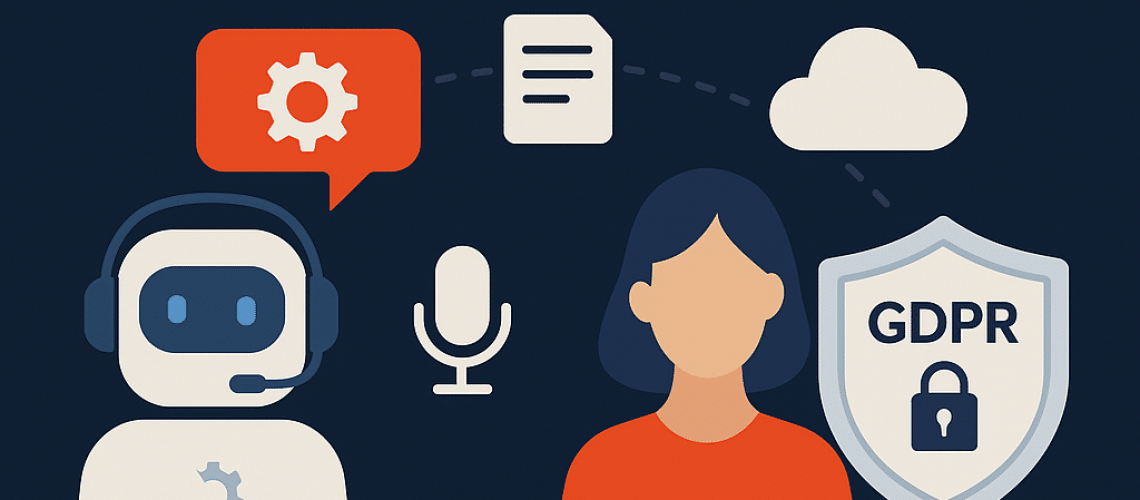
Transcription is the foundation of smart AI solutions – but what happens to privacy along the way?
We are in a technology revolution where AI is not only changing how we work – but also how we listen, analyze, and understand our conversations. In customer service, AI agents are fundamentally transforming the industry. They are fast, efficient, and available around the clock. But behind every smart answer lies something that rarely gets attention – transcription. It is thanks to automated captioning and conversation analysis that AI can learn, understand, and act. That is the core of how AI agents are trained and optimized. The efficiency is impressive. But amid all the eagerness for innovation, something fundamental is often forgotten: privacy and information security.
It is almost as if AI's capabilities are blinding us from our responsibility. We see productivity gains, better customer dialogue, and smart insights. But we miss that every word that is transcribed is also personal data, and in some cases sensitive data. What happens to the text that is generated? Who owns it? Who is allowed to analyze it? And how do we ensure that the individual's rights are not ground down in the AI machinery?
We must dare to ask the uncomfortable questions – and act accordingly.
GDPR is no obstacle – it is our safety line
In today's AI climate, GDPR sometimes appears as an annoyance. A stumbling block. But the truth is the opposite: data protection is the only thing that makes AI sustainable in the long run.
Allowing AI agents to work with transcribed call data without explicit customer consent is not only inappropriate – it can also be illegal. It also requires updated data processing agreements, clear information to call participants, and control over how subcontractors handle the data. Transparency is not optional – it is a requirement.
It is not enough to ”mean well” – structure is needed
If you are going to use AI in a responsible way, you have to start at the right end:
- Always obtain the customer's approval and be transparent about what the data will be used for.
- Update the agreement so that all forms of personal data processing are clearly regulated – including how AI may be used.
- Inform meeting participants that transcription is taking place, in the same way we do when recording.
- Review your subcontractors – especially if AI or cloud services are handled outside the EU.
This is not bureaucracy. It is fundamental respect for human privacy in an era where technology knows more about us than ever before.
The AI of the future requires more than code – it requires a compass
We stand on the threshold of something big. AI is changing the world, but we must get the right principles in place from the start. The future demands technical solutions – but also ethical compasses. And these begin with GDPR, information security, and an awareness that what we call ”data” is often someone's life, someone's voice, someone's integrity.
We in the industry need to take this seriously. Just being technically brilliant is not enough. We also need to be legally aware. Only then can we build AI agents that both help and honor those they are intended for.
For more information, please contact:
Marcus Lindqvist, CEO Responda Group
Mail: Marcus.lindqvist@respondagroup.com
Tel: +46 70-252 85 63
About Responda Group
Responda Group is a leading Nordic customer service company headquartered in Sweden. Our 500 employees handle more than 10 million customer contacts annually. With dedicated people and a flexible technical platform, Responda Group delivers high-quality, value-creating experiences and strengthens relationships for more than 2,100 clients. By being an innovative and long-term partner focused on digitalization, we create the efficient customer service solutions of the future.